 We recently viewed the Mythbusters "Penny Drop" episode. If you missed it in class or wanted to view it again, you should be able to view it at one of the following two links:
The episode tested out a physics free fall question we had discussed and calculated in class:
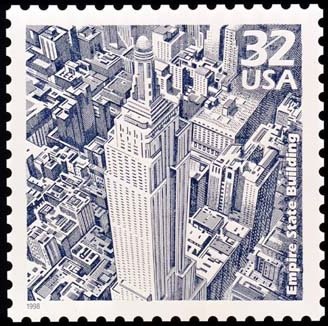
Can a penny dropped from the Empire State Building kill a person?
Knowing only the height of the Empire State Building (381 meters) and that acceleration due to gravity affects all object at a rate of 9.81 meters per second (we round up to ten to make calcuations easier), we calculated that the penny would fall for 8.73 seconds if we didn't factor in friction due to air resistance (which results in objects having a terminal velocity), and that it would hit the ground at a speed of 87.3 meters per second.
If you missed it in class, watch the video, answer ALL of these questions, hand it in and it will count as an extra quiz grade. This offer applies to students who viewed the video in class as well.
Mythbusters Penny Drop Video Questions:
What happens to the pennies when the skydiver releases them? What top speeds do their “complex” calculations predict as the terminal velocity of a penny? How does Adam test this prediction? What device does Jamie use to accelerate the penny to that speed? What should Jamie have done before testing the device for the first time? How long does it take the penny to travel the three feet from the device to the concrete block? What velocity do they actually use for their experiment? Why is ballistic gel used to build the Norma, the test dummy’s head? Where do most coins thrown from the observation deck of the ESB end up? According to the experiment, can a penny traveling at terminal velocity penetrate concrete or asphalt? According to the experiment, can a penny traveling at terminal velocity penetrate a human skull? From how far away is the penny fired at Adam’s hand? Does it break the skin? What device do they use to find out how fast a penny has to go to do serious damage? What speed does the penny reach? How many times the speed of sound is that?
Can a penny dropped from the Empire State Building kill a person?
Knowing only the height of the Empire State Building (381 meters) and that acceleration due to gravity affects all object at a rate of 9.81 meters per second (we round up to ten to make calcuations easier), we calculated that the penny would fall for 8.73 seconds if we didn't factor in friction due to air resistance (which results in objects having a terminal velocity), and that it would hit the ground at a speed of 87.3 meters per second.
If you missed it in class, watch the video, answer ALL of these questions, hand it in and it will count as an extra quiz grade. This offer applies to students who viewed the video in class as well.
Mythbusters Penny Drop Video Questions:
If you cannot view the video, ask Mr. Barkan to bring the DVD player at lunchtime and you can view it then. You MUST ask in advance and you MUST allow at least 20 minutes to view the video.


 Posts
Posts


