
 Images are now posted from the Freshman Physics Final Project
 Click here to view them or click on the photo gallery link on the side of the blog
Images are now posted from the Freshman Physics Final Project Click here to view them or click on the photo gallery link on the side of the blog

Be as creative as possible. Incorporate details about the profession to make the piece exciting or suspenseful. An interview with someone who is already in that profession will certainly help your project.
You will be presenting your story to the class.
 Here's a helpful link if you're still having issues with the many faces of speed, as well as some of the stuff we'll be studying over the next few weeks.

 Science Times, Tuesday, September 8, 2008
 This week's Extra credit assignment is to research various aspects of the measurement we know as the meter:
After you have presented your research in class (typed or legibly written, no more than two paragraphs), you may enter the information along with a link to where you got it (ALWAYS cite your sources) as a comment below.
 Every Tuesday, the NY Times has a special Science Times section. There is almost always an article or two involving areas of physics that we will be studying.
Here’s your chance to sample Physics 10, the popular course taught by Richard Muller at the University of California at Berkeley. There’s no tuition fee — and you can win a prize (Dr. Muller’s new book with the same title as the course, “Physics for Future Presidents.”, which we will occasionally use in class) if you do well on the quiz. Click for the link and a chance to enter
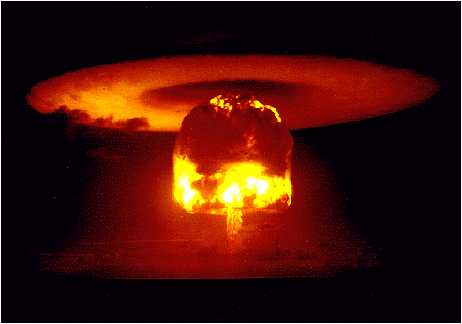
1. How does the amount of energy per gram of TNT (that's Dynamite!) compare with the energy per gram of a chocolate chip cookie?
(a) The TNT contains about twice as much as much energy.(b) The TNT contains nearly 10 times more energy.(c) The TNT contains about 1000 times more energy.(d) The cookie contains nearly 10 times as much energy.(e) They contain roughly equal amounts of energy.
2. Based on the answer to the previous question, suggest an energy-efficient way to destroy a car.
3. To generate the electric power of a large nuclear-power plant (1 gigawatt), how much land on a sunny day would an array (this means a whole bunch, placed side by side) of solar cells (at 40% efficiency) have to cover?
(a) 1 square mile(b) 16 square miles(c) 160 square miles(d) 1,600 square miles(e) 16,000 square miles (the area of California)
4. Why aren’t more solar power plants being built?
answers must be submitted as a comment on this NY Times blog:2 
Please leave the first three full pages blank.
Staples on Jericho Turnpike in Bellerose has put aside extra copies for our class, so if you don't see these, ask!
Scientific or Graphing Calculator - bring the calculator you need for Ms. Sadera's Algebra class (preferably a TI-83 or better).
Pen AND pencil, every daySmall Metric ruler (6", acrylic), and you can print an additional ruler from here
Protractor, and you can print an additional protractor from here
Compass
Keep at home for projects:
 We recently viewed the Mythbusters "Penny Drop" episode. If you missed it in class or wanted to view it again, you should be able to view it at one of the following two links:
If you cannot view the video, ask Mr. Barkan to bring the DVD player at lunchtime and you can view it then. You MUST ask in advance and you MUST allow at least 20 minutes to view the video.
 We recently used the launching of paper airplanes (we used index cards in class) to develop our concept of acceleration.
 Our research question for this next investigation (& ongoing report) is given two similar Hot Wheels cars, how do we determine beyond a doubt which one is faster?
As we discussed in class, this will involve designing experiments, writing procedures, trying them out, rewriting them, trying them out again, and so on until we can accurately answer the question.
The second question, of course, is to come up with definite reasons WHY one is faster than the other.
Questions from Class - Based on your understanding of Speed:
What does speed measure?
What is the Formula for Average Speed?
What is the difference between average speed and instantaneous speed?
An airplane is flying at a constant (also called “uniform”) speed of 400 miles an hour for three hours.
1. What is the plane’s instantaneous speed two hours into the flight?
2. How far will the plane travel in three hours?
3. How far will the plane travel in thirty minutes?
A runner runs at a constant speed of 7 mph in a marathon (note: a marathon is a race of 26.2 miles).
1. How far would she run in:
- One hour?
- Two hours?
- Three hours?
- Three hours, 30 minutes?
2. What was her time at the 14 mile mark?
3. What was her average speed during the race?
Extra Credit: One point each, answers must be precise to the second. Print this out and give it to Mr. Barkan with your answers (show ALL work or no credit!) no later than 2:30 pm on Thursday, November 1st for credit.
i. How long (in hours, minutes and seconds) did it take her to finish the marathon?
ii. What was her pace per mile? (i.e., How long, in minutes and seconds, did it take her to run a mile at that pace)?
iii. If she ran the marathon at a constant speed of 10 minutes per mile, how long would it take her to finish?
iv. What are the current NYC Marathon Men’s and Women’s Course Records?
v. What pace (constant speed) would a Male and a Female runner have to maintain to beat the current NYC Marathon Course Records?
vi. What will the winning times be for the first male and female finishers at the NYC Marathon on Sunday, November 4th, 2007?
 Our first formal investigation into the world of Newtonian mechanics saw a bowling ball being hurled down 120 feet of hallway.
 Those students who have taken the time to read this will know that while we can try to figure out the ball's speed every 15 feet mathematically, it will prove far simpler to graph the data and interpret the graph to answer the question of what happened to the ball's speed as it moved down the hallway.
 (!) Show this to your parents (!)
What grade did you get?
Your first report has been marked with comments but has not been graded. The number of comments on your report does not necessarily affect your grade.
Please read carefully the comments we have taken the time to write down and make sure that your resubmitted report addresses all of them.
DUE DATE – In Class on MONDAY, SEPTEMBER 24, 2007
You must resubmit the report in class on Monday, with the original report attached at the back. We will again grade it and get it back to you as soon as possible.
Late Reports
Do not submit your report late. Late reports will lose 10 points (one letter grade) every day, including weekend days. DO NOT SUBMIT YOUR REPORT LATE!
Resubmission Policy
Each time a report is returned to you, you will have the opportunity to resubmit the report. You may resubmit a graded/commented report as many times as you want, however you must completely rewrite the report each time.
Resubmission Deadline
You will have up to a week after your report is returned to you to resubmit it. No resubmitted reports will be accepted after that week has passed.
Spelling & Grammar
No points will be taken off for spelling or grammar problems the first time you submit your report. However if you do not correct them when you resubmit your report, you will have points deducted.
Number your pages and make sure your name is on every page.
How Long Should The Report Be?
Longer is not always better. Be clear and accurate. Diagrams & drawings that help explain what you are describing are an important part of physics.
Writing Style
The purpose of the lab report is not to tell a story. Take “You” out of the introduction, materials list and procedures. It is acceptable to discuss your experiences in the observations section as you recall it and also to ask questions in the conclusions section.
Make Each Section Distinct:
Your introduction or the summary of your investigation should not include the detailed list of steps (the procedure) that describes how to do the investigation was conducted.
The procedure should not include your observations.
Be sure your conclusions are not part of your observations, and it’s always nice to end your report with a mention of additional things you might want to try based on the results of this investigation.
Find a Friend
Reread your report before you submit it. Have someone in your group read it as well or ask Ms. Purpura or Mr. Barkan to look it over before the due date so you have a chance to redo your report if necessary. We will do this in class on Monday.

 Posts
All Comments
Posts
All Comments


